
Looking at warehouse job postings across Ontario, you will see employers asking for three main machines: Counterbalance, Reach Truck, and Order Picker.
If you are a beginner, start with a Counterbalance forklift to learn basic driving and load handling, or choose a Reach Truck to qualify for higher-paying indoor warehouse jobs. Under Ontario safety regulations, you must hold a specific certification for each machine class you operate.
At CN Forklift Training, our hands-on forklift training program in Mississauga gets you certified in just 1 to 2 days, giving you the practical skills and confidence to pass employer driving evaluations on day one.
What Is the Difference Between an Order Picker, Reach Truck, and Counterbalance Forklift?
Under the Canadian Standards Association (CSA) Standard B335, industrial lift trucks are divided into separate equipment classes. Each machine is engineered for a specific warehouse task, meaning they steer, balance loads, and move through aisles differently.
1. Counterbalance Forklift (The Warehouse Workhorse)
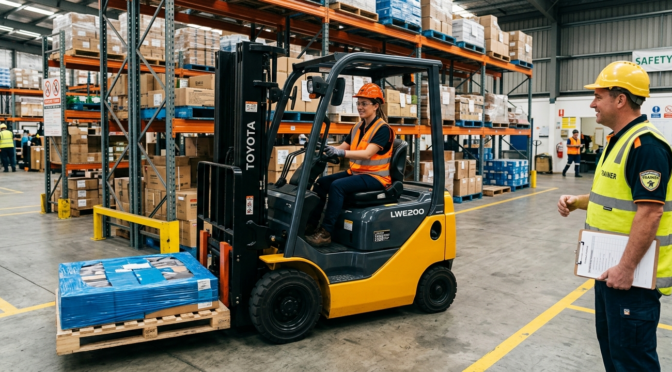
The Counterbalance forklift is the standard machine most people recognize. You sit facing forward in a protective cab, just like driving a car. A heavy cast-iron weight at the back balances heavy pallets on the front forks. It is the primary machine used on flat loading docks, inside shipping trailers, and in outdoor freight yards.
2. Narrow Aisle Reach Truck (The High-Racking Specialist)
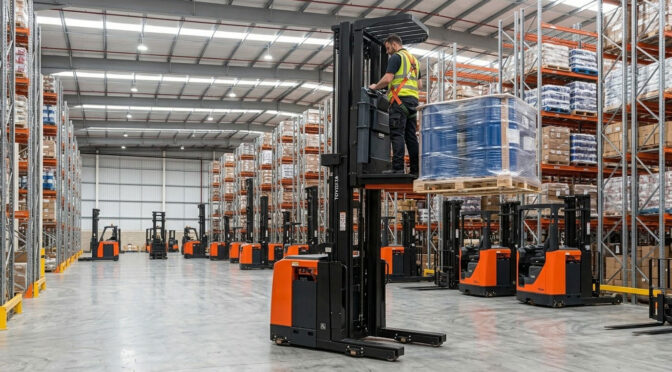
A Reach Truck is an indoor machine designed for warehouses with tall storage racks. Instead of a rear counterweight, it uses two forward stabilizer legs (outriggers). Its scissor-like metal arms push the forks forward into deep racking bays to place or retrieve pallets up to 30 feet high. You operate this machine while standing sideways.
3. Order Picker (The Elevated Picking Machine)
On a standard forklift, only the metal forks move up and down. On an Order Picker, you stand on an enclosed platform that travels into the air alongside the forks. This design allows you to elevate yourself 20 to 30 feet to hand-pick individual boxes, cartons, or parts off high shelves in retail and e-commerce warehouses.
Equipment Comparison Summary
Here is how the three machines compare across our certified equipment courses:
| Machine Type | Operator Stance | Primary Work Area | Aisle Width Needed | Lift Height | Safety Restraint | Best Purpose |
| Counterbalance | Sit-down | Loading docks, trailers, yards | 12 to 14 feet | 10 to 18 feet | Seat belt | Moving bulk freight & loading trucks |
| Reach Truck | Stand-up (Sideways) | High-bay storage racking | 8 to 10 feet | 20 to 35+ feet | Enclosed cab | Stacking pallets in narrow aisles |
| Order Picker | Elevating platform | E-commerce, retail parts | 5 to 8 feet | 15 to 30+ feet | Full-body harness & lanyard | Hand-picking individual boxes |
How Hard Is Each Machine to Drive for a Beginner?
Each lift truck has a different control layout and steering feel. Understanding the learning curve helps you choose a course that matches your comfort level.
Counterbalance: Easy Car-Style Driving
The Counterbalance forklift is the easiest machine to learn because the layout feels familiar immediately.
- The Controls: You sit in a standard seat, steer with a steering wheel, and use foot pedals for acceleration and braking.
- The Main Challenge: Forklifts steer using the rear wheels, which causes the back end to swing out wide on turns. Our instructors teach you how to judge this rear-swing clearance so you avoid bumping into walls or pallets.
Reach Truck: Sideways Stance and Joystick Controls
The Reach Truck requires a bit more coordination because of its stand-up driving position.
- The Controls: You stand sideways inside an enclosed compartment. Your left hand steers with a small tiller knob, while your right hand uses a multi-function joystick to control speed, lifting, and fork extension.
- The Main Challenge: Standing sideways feels unusual at first, but it gives you clear visibility forward and backward without twisting your neck. With 1-on-1 coaching, most students master these controls in a few hours.
Order Picker: Simple Driving, But Working at Heights
Driving an Order Picker is mechanically simple, but it requires comfort working above the ground.
- The Controls: You stand facing the forks with a straightforward control handle that regulates travel speed and vertical height.
- The Main Challenge: Because the platform carries you 20 to 30 feet into the air, you must wear a CSA-approved full-body harness connected to an overhead anchor. Following proper safety routines makes operating at height secure and stable.
Which Forklift Certification Pays More in Ontario?
Material handling wages across the Greater Toronto Area (GTA) depend directly on the machinery you are licensed to operate. Warehouses in Mississauga, Brampton, Toronto, and Vaughan prioritize operators who can handle specialized equipment in high-density storage environments.
- Counterbalance Operators ($19.50 to $23.50/hr): Counterbalance driving is the most common entry-level role across freight terminals, transport docks, and manufacturing plants. If you are exploring regional warehouse openings or looking to enroll in forklift training in Brampton, this credential helps you get hired quickly.
- Reach Truck Operators ($21.50 to $26.50+/hr): Reach Truck drivers consistently earn top hourly wages in the GTA logistics sector. Major distribution centers that recruit operators who completed forklift training in Toronto pay higher starting wages because placing heavy pallets into 30-foot racking bays requires precision.
- Order Picker Operators ($20.00 to $24.50/hr): Retail, grocery, and e-commerce distribution centers hire Order Picker operators for fast-paced fulfillment shifts. Many facilities offer performance bonuses on top of base hourly wages for maintaining high order accuracy.
- Multi-Certified Operators ($23.00 to $28.00+/hr): Operators who hold valid licenses for Counterbalance, Reach Truck, and Order Picker are the first candidates selected for full-time hiring, shift lead responsibilities, and overtime assignments.
Decision Guide: Which Forklift Course Should You Take First?
Use this simple decision framework to select your starting certification:
1. Choose Counterbalance First If:
- You have never operated industrial machinery before and want an easy learning curve.
- You prefer sitting down during your working shift.
- You want to work on shipping docks, freight yards, or manufacturing assembly floors.
2. Choose Reach Truck First If:
- You want to target higher-paying indoor warehouse positions right away.
- You are comfortable standing during your shift and using joystick controls.
- If you are preparing to enroll in Forklift License Training in Oakville or anywhere across Halton logistics parks, holding a reach truck ticket gives you an immediate hiring advantage.
3. Choose Order Picker First If:
- You want to work in retail fulfillment, consumer parts, or pharmaceutical supply centers.
- You are comfortable working on an elevated platform while wearing a safety harness.
Why Ontario Warehouses Prefer Operators with a Multi-Equipment Combo
While a single certification helps you land an entry-level job, earning a Multi-Equipment Combo Certification (Counterbalance + Reach Truck + Order Picker) makes you far more versatile to employers.
In a busy warehouse, daily workflow changes throughout a shift:
- Morning: You use a Counterbalance forklift to unload freight trailers arriving at the loading dock.
- Midday: You switch to a Reach Truck to transport those pallets and slot them into 30-foot storage racks.
- Afternoon: You step onto an Order Picker to help your team complete rush customer case orders.
Warehouse managers prefer hiring operators who can transition between equipment without delays. At our Mississauga training facility, you can complete a multi-equipment combo package in just 1 to 2 days. We also offer corporate scheduling for employers requiring on-site corporate forklift training directly at their facility.
Start Your Forklift Training Today
Getting certified is a straightforward process that pays off immediately in better job opportunities and higher hourly pay. Whether you choose to start with a single machine or complete a multi-equipment combo package, our instructors provide the 1-on-1 practical seat time you need to operate with confidence.
If you are looking for accredited Forklift Training Near Me with flexible weekend schedules and same-day certification, our facility is ready to help you take the next step.
- Training Facility Address: 7033 Telford Way, Unit #4, Mississauga, ON L5S 1V4
- Operating Hours: Open 7 Days a Week (Morning, Afternoon & Weekend Slots)
- Locations Served: Mississauga, Brampton, Toronto, Vaughan, Oakville, Milton, and the entire GTA.
Ready to get certified? Call (905) 405-0001 today or contact our admissions desk to reserve your seat in this week’s hands-on class.
FAQs
Does a Counterbalance license let me drive a Reach Truck?
No. Under CSA Standard B335, licenses are equipment-specific because steering, controls, and stability systems differ between machine classes.
Do I need a regular driver’s license to take forklift training?
No. You do not need an Ontario driver’s license to operate a forklift in a warehouse—you only need to be at least 18 years old and formally certified.
Why do I have to wear a harness on an Order Picker?
Because the platform lifts you 20 to 30+ feet into the air, Ontario safety regulations require a full-body harness and lanyard to prevent falls.
Which forklift course is best for someone with no warehouse experience?
The Counterbalance forklift is the easiest starting point for beginners, while a combo package with a Reach Truck provides the strongest job opportunities.
Can I get certified on all three machines in one weekend?
Yes. Our weekend combo courses cover classroom theory and all hands-on driving tests in 1 to 2 days, with same-day certificate issuance.
How long is my forklift certificate valid in Ontario?
Forklift certification is valid for 3 years under Canadian standards, after which you complete a brief refresher course and driving test to renew it.