
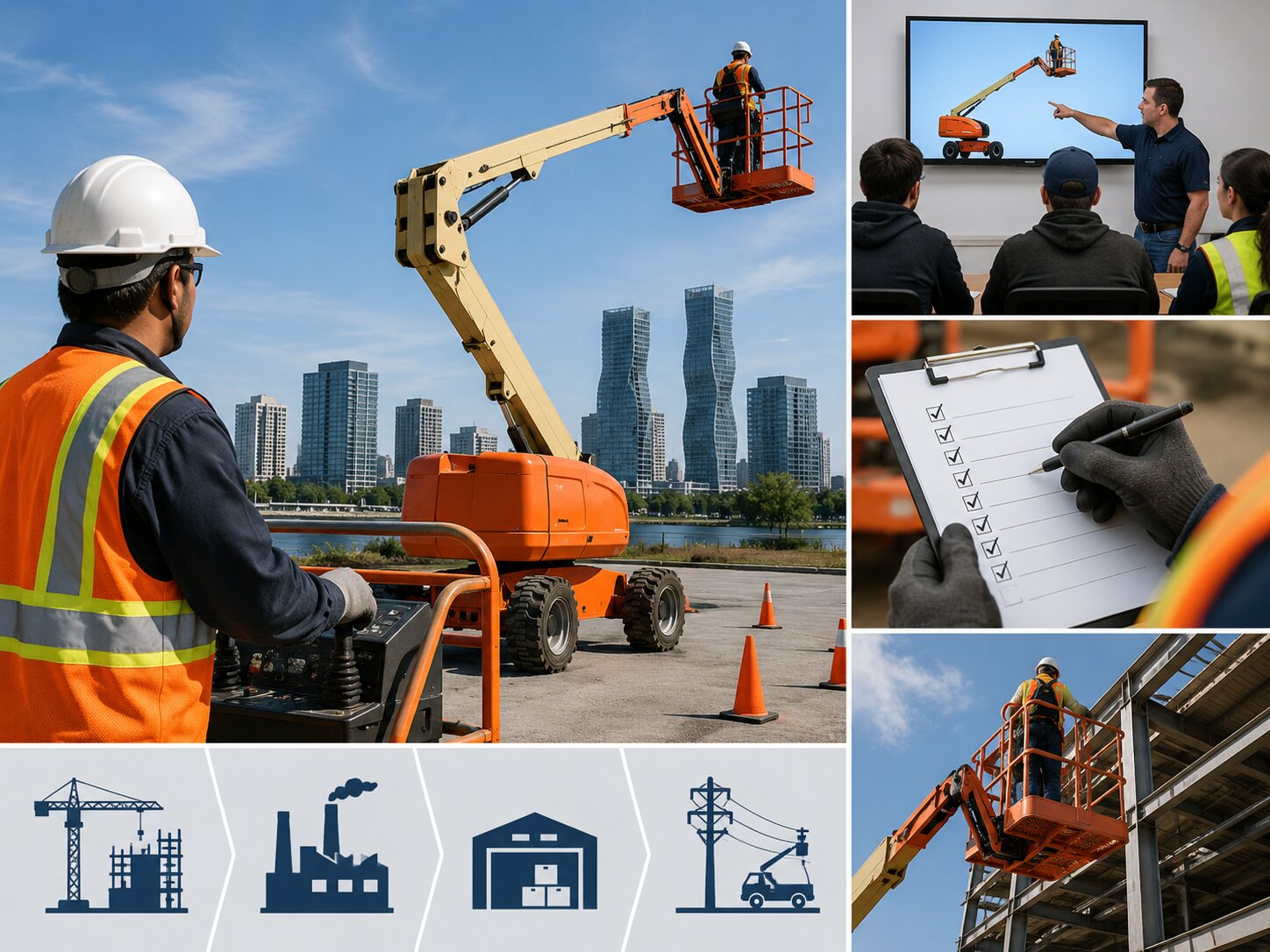
Boom lifts are common equipment on construction sites, in industrial facilities, and across maintenance operations throughout Canada. Before any operator steps onto a job site and into a platform basket, they need a valid certification. No job site in the GTA will waive that requirement.
This post covers what boom lifts are, where they are used, why certification is mandatory, and what a training course actually includes.
A boom lift is a machine that raises workers and their tools to elevated positions using an extendable hydraulic arm on a wheeled base. The arm lifts and positions a platform basket where the operator stands to do the work.
In Canada, boom lifts are officially classified as MEWPs: Mobile Elevating Work Platforms. That is the term used in Ontario workplace safety regulations and Canadian standards. You may also hear them called AWPs (Aerial Work Platforms) or EWPs (Elevating Work Platforms). They all refer to the same category of equipment.
There are two main types, and they work differently.
| Articulating Boom Lift | Telescopic Boom Lift | |
| How the arm moves | Bends at multiple joint points | Extends in a single straight line |
| Best suited for | Tight spaces, working around obstacles, indoor access | Open areas, high vertical reach, outdoor construction |
| Typical reach | Up to ~150 ft | Up to 185–210 ft |
| Also known as | Cherry picker, knuckle boom | Stick boom, straight boom |
| Common power source | Electric (indoor) or diesel (outdoor) | Diesel |
An articulating boom can bend its arm to reach up, over, and around obstacles. That makes it the right choice for indoor work, congested job sites, and areas with limited access. A telescopic boom extends in one straight direction and reaches greater heights, which suits open construction sites and exterior building work.
Both types are covered under Ontario’s certification requirements. Operators must be trained on the specific equipment they will actually use on site.
Boom lifts are used wherever workers need to reach heights that ladders and scaffolding cannot safely serve. Certified operators are in demand across a wide range of industries in Ontario.
Ontario’s construction sector is projected to grow through 2027 and beyond, driven by infrastructure investment and a sustained housing demand. At the same time, more than 30% of the province’s certified tradespeople are expected to retire before 2030. That gap is creating steady demand for workers who hold the right credentials.
Workers seeking boom lift certification in Toronto and across the GTA will find that most active job sites treat certification as a site-access requirement, not a suggestion. Without it, operators are turned away regardless of how much hands-on experience they have.
Yes. Training is mandatory.
Ontario does not issue a government boom lift licence the way it does a driver’s licence. But under the Occupational Health and Safety Act, every employer must ensure that workers are trained and competent before operating any elevated work platform. Competent means more than holding a certificate. It means the worker understands the equipment, knows how to identify hazards, and can operate it safely.
The employer carries the legal responsibility for making sure that training happens. If an untrained operator is injured on a job site, the employer faces serious liability.
Training must cover the manufacturer’s instructions for the specific machine, the equipment’s load limits, a hands-on demonstration of all controls, and what surfaces the equipment is and is not designed for. Online-only certifications do not meet this standard. Ontario requires a practical, hands-on evaluation as part of any valid program. Workers who complete theory online without a practical component will still need to attend an in-person course before most employers and job sites accept their credentials.
Ontario introduced a new standalone regulation for elevating work platforms in 2026. It takes effect January 1, 2027, and it applies to all workplaces, not just construction projects. It adds more detailed training, recordkeeping, and equipment-use requirements for employers.
Workers already certified under the current rules have a transition period. But employers should review their training records in 2026 to confirm everything is in order before the new rules come into force.
Getting recognized boom lift training in Ontario this year is the practical way to stay ahead of that deadline.
We offer boom lift certification in Mississauga at our facility at 7033 Telford Way, Unit 4. On-site training is also available for employers who need to certify a team at their own location across the GTA and Ontario.
Our course covers everything an operator needs to work safely and meet Ontario’s requirements.
The theory component covers how boom lifts work, how to read load capacity limits, how to assess ground conditions before positioning the machine, how to identify overhead hazards, including power lines, and how to use fall protection equipment correctly. Emergency procedures are covered as well.
Operators complete a hands-on evaluation on actual equipment. This includes a pre-use inspection, raising and lowering the platform smoothly, turning and repositioning at height, and demonstrating hazard awareness during operation. Both the theory and practical components must be passed to receive certification.
Course details at a glance:
Our course meets the requirements for boom lift training in Ontario and aligns with the operator training standards under CSA B354.8:17.
Boom lifts are used across Ontario’s busiest industries, and the demand for certified operators is only growing. Certification is a legal requirement, a job site access requirement, and a career asset.
Whether you are getting certified for the first time or your employer needs to bring a team up to standard, we run courses seven days a week at our Mississauga facility and on-site across the GTA, including Toronto, Vaughan, Brampton, Scarborough, and the surrounding region.
For boom lift certification in Mississauga, at your facility, or anywhere across Ontario, CN Forklift Training is open 7 days a week. Call (905)-405-0001 or (905)-405-0006 to book. On-site quotes are available for employer group training.
Is boom lift certification the same as scissor lift certification?
No. Boom lifts and scissor lifts are different types of equipment with different mechanics and different risk profiles. Each requires its own certification. A scissor lift ticket does not cover boom lift operation.
Who needs boom lift certification in Mississauga and the GTA?
Any worker who will be operating a boom lift on a job site needs to be certified. The employer is responsible under Ontario law for making sure that happens before the operator uses the equipment.
How long does boom lift training take?
It depends on your experience level, the size of the group, and how quickly participants demonstrate safe, competent operation during the practical assessment. Contact us directly to get an accurate estimate for your situation.
Can a group of workers be trained at the same time?
Yes. Group and employer-sponsored bookings are available at our training facility and on-site across the GTA and Ontario.
Where can I get boom lift certification in Toronto?
Workers looking for boom lift certification in Toronto can train at CN Forklift Training’s Mississauga facility, which is a short drive from the city, or book on-site training directly at their Toronto location.
Does Ontario’s new EWP regulation affect existing certifications?
Ontario’s updated regulation for elevating work platforms takes effect January 1, 2027. Workers certified under the current standard have a transition period. Employers should review their training records this year to make sure everything is in order before the new requirements come into force.
Don't see your city? We provide on-site training throughout Ontario. Contact us for availability.