
In modern warehousing and material handling, choosing the right forklift can directly impact productivity, safety, storage capacity, and operator efficiency. One of the most common comparisons businesses make is reach truck vs counterbalance forklift. While both machines are designed to move and lift materials, they serve very different purposes inside a warehouse environment.
Many warehouse managers, logistics coordinators, and new operators assume all forklifts work similarly. In reality, using the wrong machine for the wrong application can lead to damaged inventory, reduced efficiency, and even safety risks. This is why understanding the core differences between a reach truck and a Counterbalance Forklift is essential before investing in equipment or enrolling in operator training.
At CN Forklift Training, this is one of the most common topics discussed during operator education and workplace safety sessions. Businesses across Canada are increasingly focusing on proper forklift selection, practical operator training, and certification standards to improve workplace performance and compliance.
This guide explains the real-world differences, practical applications, strengths, limitations, and training requirements for both forklift types.
Before comparing machines directly, it’s important to understand how different types of warehouse equipment are designed for specific operational needs.
Forklifts are not “one-size-fits-all” machines. Warehouses vary in:
The forklift that works perfectly in a retail distribution center may perform poorly in a manufacturing facility or lumber yard.
Among all warehouse forklift types, reach trucks and counterbalance forklifts are two of the most widely used machines because they handle very different material-handling tasks.
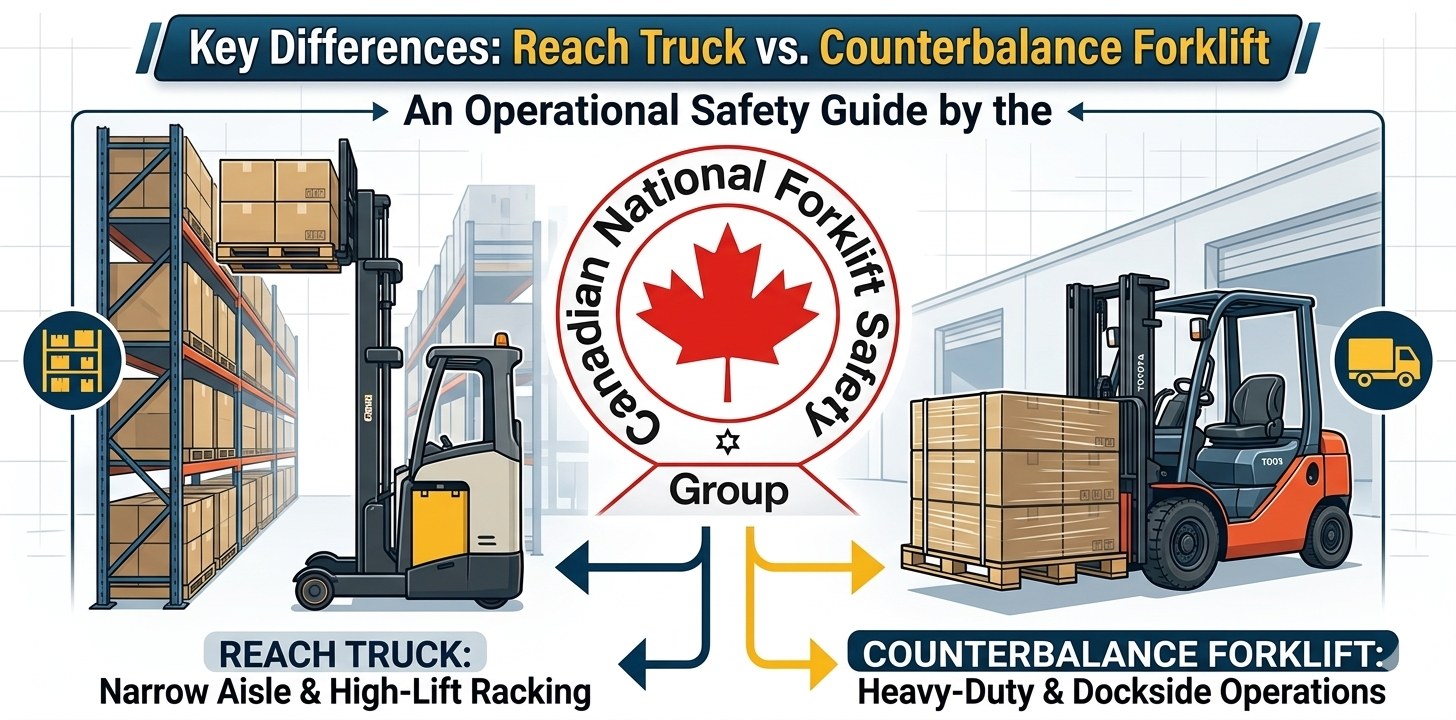
A reach truck is a specialized forklift designed primarily for narrow-aisle warehouse operations and high-level pallet storage.
The defining feature of a reach truck is its extending mast mechanism. Instead of driving directly into shelving like traditional forklifts, the forks “reach” forward to place or retrieve pallets from racking systems.
Reach trucks are commonly found in:
Because of their precision handling, they are ideal for maximizing vertical storage space.
A Counterbalance Forklift is the traditional forklift most people recognize. It uses a rear counterweight to balance heavy loads lifted at the front.
Unlike reach trucks, counterbalance forklifts do not require support legs beneath the load. Operators can drive directly toward pallets, making them highly versatile.
These forklifts are commonly used in:
Their flexibility makes them one of the most widely used types of warehouse equipment worldwide.
Understanding the operational differences helps businesses choose the right equipment for efficiency and safety.
Reach trucks are engineered for narrow warehouse aisles. Their extending forks allow operators to retrieve pallets without turning large machines inside tight spaces.
The operator compartment is often side-facing, allowing better visibility while maneuvering through narrow racking systems.
A Counterbalance Forklift uses a heavy rearweight to stabilize loads. Since there are no front stabilizing legs, operators can approach pallets directly.
This design is better for loading trucks, moving pallets outdoors, and transporting heavier loads over shorter distances.
One major advantage of reach trucks is vertical lift capability.
In real warehouse operations, reach trucks are often preferred when storage density matters more than transport versatility.
Reach trucks excel in narrow aisles. Their compact turning radius allows operators to work efficiently in tight warehouse layouts.
Warehouses using high-density storage systems often rely heavily on reach trucks to save floor space.
Counterbalance forklifts require wider aisles to turn safely. However, they provide better movement flexibility across mixed-use environments.
This makes them more adaptable for facilities handling both indoor and outdoor logistics.
Every forklift type performs best in specific operational environments.
Reach trucks are ideal for:
A retail distribution center storing thousands of SKUs often uses reach trucks because maximizing vertical storage significantly reduces warehouse expansion costs.
A Counterbalance Forklift is better suited for:
A construction materials supplier moving pallets between warehouse floors and outdoor loading areas benefits more from counterbalance forklifts due to terrain flexibility and load stability.
One of the biggest misconceptions in warehousing is assuming forklift operation is simple after basic orientation.
In reality, reach trucks and counterbalance forklifts require different handling techniques, visibility awareness, and stability management.
This is where proper operator training becomes critical.
In Canada, forklift operators are expected to receive proper workplace safety training under provincial occupational health and safety regulations.
While certification requirements vary slightly by province, employers are generally responsible for ensuring operators are trained and competent.
Operators are usually assessed through:
Proper reach truck certification Canada programs help reduce workplace accidents and equipment damage significantly.
Many facilities operate multiple types of forklifts. Employees who understand the operational differences between machines become safer and more efficient.
This is where forklift comparison training becomes highly valuable.
Instead of learning only one machine, operators understand:
At CN Forklift Training, comparison-based learning often helps new operators build stronger situational awareness faster than isolated machine instruction alone.
A cheaper forklift can become expensive if it reduces productivity or causes inventory damage.
For example:
Equipment should match operational workflow—not just budget.
One of the most common warehouse planning mistakes involves aisle sizing.
Reach trucks require less aisle space than counterbalance forklifts. Businesses sometimes buy standard forklifts before realizing their warehouse layout limits maneuverability.
This often results in:
Even experienced operators can struggle when switching forklift types.
A counterbalance forklift operator may initially find:
Proper forklift operator courses help prevent these adjustment problems.
High lifts increase tipping risks and visibility challenges.
Operators should:
Small steering errors can damage expensive racking systems.
Experienced operators continuously monitor:
Heavy loads positioned too far forward reduce stability.
Operators should always:
Uneven surfaces increase tipping risk.
Operators must adjust speed based on:
Warehousing has evolved dramatically over the past decade.
Today’s logistics operations focus heavily on:
This has increased demand for specialized logistics training programs across Canada.
Companies now value operators who understand:
Comprehensive operator training helps businesses remain competitive while reducing costly operational mistakes.
Experienced warehouse managers often avoid relying on only one forklift type.
Instead, many successful facilities combine:
This hybrid approach improves:
Another important insight from experienced operators is that comfort and visibility matter more than many businesses realize. Poor ergonomics can reduce productivity during long shifts.
Testing equipment in real operating conditions before purchase often prevents expensive long-term mistakes.
Modern warehouse equipment is becoming increasingly advanced.
Emerging forklift technologies include:
As automation grows, trained operators remain essential because real warehouse environments still require human judgment, adaptability, and safety awareness.
This makes professional forklift operator courses and ongoing skills development increasingly valuable.
Understanding the differences in reach truck vs counterbalance forklift operations is essential for making smarter warehouse decisions.
While reach trucks excel in narrow aisles and high storage environments, the Counterbalance Forklift remains the preferred choice for versatile loading, transport, and outdoor operations.
The best choice depends on:
Businesses that combine the right equipment with proper operator training, forklift comparison training, and safety-focused workplace practices typically achieve better efficiency, fewer accidents, and stronger long-term operational performance.
At CN Forklift Training, educating operators on real-world forklift applications helps businesses build safer and more productive warehouse environments across Canada.
A reach truck is designed for narrow aisles and high shelving, while a counterbalance forklift is better for general material handling and loading operations.
Reach trucks are better for high-density warehouse storage because they can operate efficiently in tight aisles and lift pallets to greater heights.
Yes, a Counterbalance Forklift is commonly used outdoors because it handles uneven surfaces and loading dock operations more effectively.
Yes, operators should complete proper reach truck certification and safety training to meet workplace safety standards in Canada.
Forklift operator training improves workplace safety, reduces accidents, protects inventory, and helps operators handle equipment more efficiently.
Don't see your city? We provide on-site training throughout Ontario. Contact us for availability.